|
||||||||||||||||||||
|
| ||||||||||||||||||||
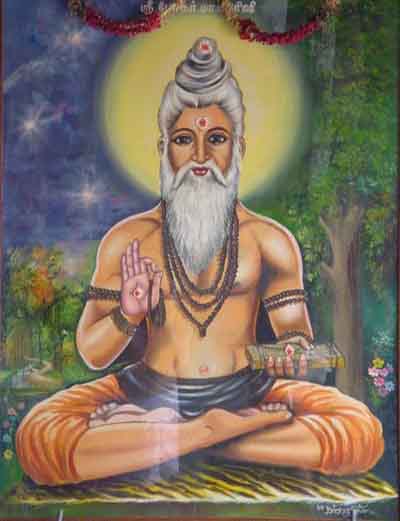
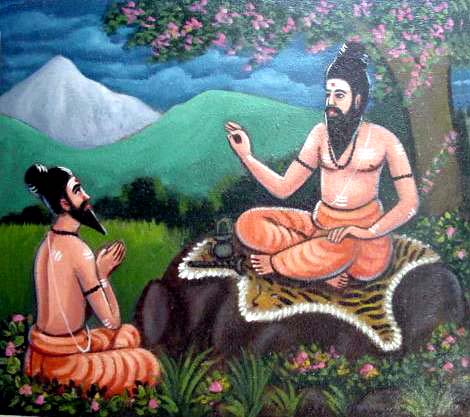
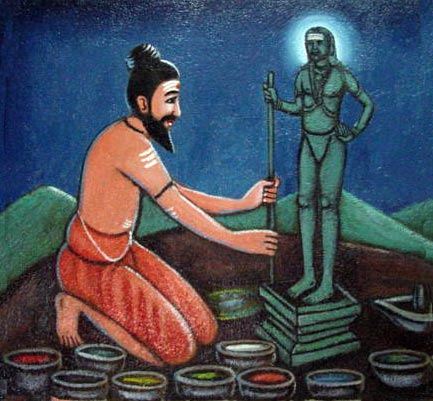
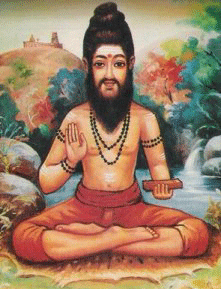
The Life of Bhogar SiddharClick on any picture to visit: The Life of Bhogar in Pictures.
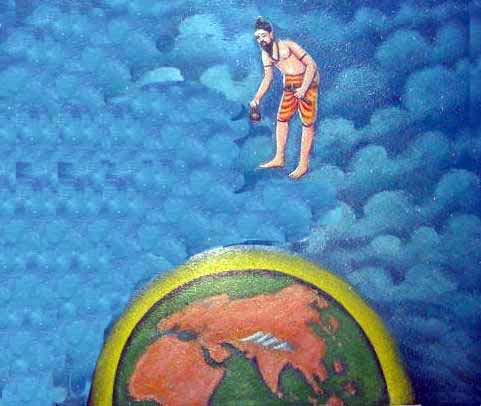
It is said that as per the last wishes of his guru, Bhogar proceeded to China to spread the knowledge of siddha sciences and strangely enough his journey is said to have been made with the aid of an aircraft; he demonstrated to the Chinese the details of the construction of the aircraft and later built for them a sea-going craft using a steam engine. The details of these and other experi- ments demonstrated by Bhogar in China are clearly documented in the Saptakanda. Bogar's guru, Kālāngi Nāthar, is believed to be a Chinese who attained siddhi in South India and thus became included among the Eighteen Siddhars. Lao Tse - the founder of Taoism (5th century B.C.) was the first Chinese to propound the theory of duality of matter -- the male Yang and female Yin -- which conforms to the Siddha concept of Shiva - Shakti or positive-negative forces. This very same concept was first revealed by the adi-siddhar Agasthya Rishi, whose period is as old as the Vedas, which have been conservatively dated at 3500 B.C. Also alchemy as a science was practised in China only after B.C. 135 and was practiced as an art until B.C. 175 when a royal decree was enacted banning alchemical preparation of precious metals by the Celestial Empire; these details are recounted in the two existing Chinese books of alchemy Shih Chi and Treatise of Elixir Refined in Nine Couldrons, both dated to the first century B.C. The emergence of Lao Tse with his theory of duality of matter and the journey of Bhogar to China seem to have taken place about the same time and it is even possible that Bhogar himself went under the name of Lao Tse in China, like another Siddharishi Sriramadevar, who was known as Yacob in Arabia. This seems likely considering that:
The shrine at the top of the hill, though later than the Tiru Avinankudi temple, has overshadowed the older temple in the present century due to its popular appeal. Created by Bhogar, it was maintained after him by sage Pulippani and his descendants almost as their personal and private temple. During the time of Tirumalai Nayak, his general Ramappayyan handed over the puja rights to newly brought Brahmin priests. The descendants of Pulippani were compensated for the loss of this right by being given:
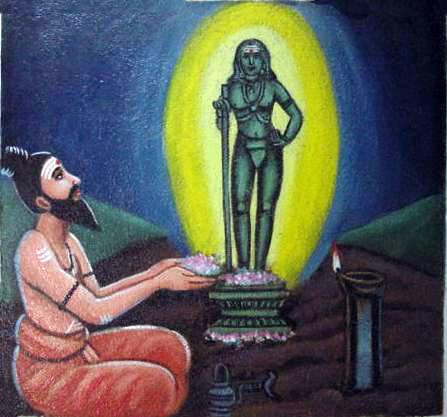
Gateway of Earth & StoneAt the top of Palani Hill, near the holy Murugan which Bhogar had crafted from nine poisonous substances, there is an opening in the Earth; it is a hole in the ground; the mouth of a cave which lies below. Bhogar often lowered himself into the Earth, sat in the cave, accessing Life's hidden secrets. He performed great austerities there, the magnitude of which very few in this modern age can fathom. There at the opening Bhogar erected a humble shrine to the Great Mother: a few yantras, a couple of five-metal icons baring the form of the Mother and her son Murugan. He worshipped a small emerald lingam there, about ten inches in height. His one and only disciple, Pulipani (perhaps the only one who truly understood the sage), kept him company at the entrance to the underground cavern on the top of Palani Hill. When Bhogar felt that his outer work was done, he entered the gateway of earth and stone and sat down in the darkness of the cave. Faithful Pulipani heaved a stone slab over the entrance, sealing Bhogar forever in the blackness of his earthen womb. For thirteen generations Pulipani's descendants have watched over that stone slab that marks the gateway to the underground chamber. Long ago, Bhogar's little shrine was set atop that hallowed spot, and even today, is still worshipped by the vigilant sons of the faithful Pulipani. They say that Bhogar is seated quietly in meditation even now; alone in the darkness; watching the slow passage of time. His breath is still. His mind is quiet, his heart unwavering; but through the dense dark matter of his earthly form stabs the vibrant & relentless flame of the Kundalini Shakti. There he waits... Courtesy: Forward to Shaking the Tree: Kundalini Yoga, Spiritual Alchemy, & the Mysteries of the Breath in Bhogar's 7000 English rendering by Layne Little
|